
On the ferry across the Guadiana, I hesitate over a greeting.
It lasts just long enough to notice – that half-second between switching from Spanish to Portuguese.
The man checking the tickets is looking toward the other side of the river. I say bom dia, then immediately soften it, Andalusian-style, consonants slipping away before they fully arrive. He answers with a smile. Nobody here seems especially interested in being correct.
This is the Spain–Portugal border: Europe’s oldest, and one of its quietest. The river marks it cleanly on maps, a blue line doing the work of centuries. It’s nicknamed La Raya / A Raia (The Line – one that stretches 1234km). But in speech it blurs. You hear it most clearly in the in-between border places – the shops and cafés of the villages and towns either side of the border, the waiting spaces by the ferries that shuttle across from one country to the other in a mere 15 minutes. You can of course cross by bridge (or even zip line in summer if you’re feeling intrepid) but I opt for the ferry crossing – preferring the clear sense of departure and arrival.
Having lived in Andalucía, Spain’s southernmost region, which borders Portugal, I learnt Andalusian Spanish early on. It’s a version of Spanish that it is playful, soft, sometimes considered linguistically careless (words get swallowed part way through, take on new expressions, sentences dance with musicality). And it travels well. It lets go. It adapts. It doesn’t insist on being heard in full.
That matters at a border like this.
On the Portuguese side, in Vila Real de Santo Antonio, I spot menus printed up with Portuguese on one side, Spanish on the other. On the Spanish side, in Ayamonte, they’re written quickly in chalk on boards. Spoken language behaves differently again. Sentences drift. Verbs mingle. Grammar follows a more instinctive rhythm.
Linguists have a name for this – Portuñol, or Portunhol – (a mix of Spanish and Portuguese) but nobody I speak to uses it straight away. What’s happening here isn’t a new language so much as a shared willingness not to insist on purity. People meet each other halfway, or don’t bother figuring out where the middle is at all. A similar hybrid language usage can be found in the south of Brazil or the north of Uruguay (again where Portuguese and Spanish meet).
What interests me is who switches first.
It’s rarely the same person. Sometimes it’s the older speaker, sometimes the younger. Sometimes it’s simply whoever senses, instinctively, that understanding matters more than form. And sometimes nobody switches – the conversation banking instead on rhythm, gesture, context, the slow accumulation of meaning.
Borders were once far more divisive here. The Portuguese dictatorship on one side, the Spanish on the other. Smuggling routes. Informal crossings. You can still hear that history in the way people speak – cautious, economical, uninterested in display.
What survives isn’t the standard language taught in schools. It’s the spoken one: elastic, forgiving, and mutually understood. There’s a kind of environmental logic to this. Languages that adapt survive longer. In villages stretched thin by emigration and age, with dwindling populations, speech has to work. And so it crosses the borderlands back and forth.
Nobody here frames this as politics. But it is political all the same.
Standardised language has always favoured centres over edges, capitals over margins. At borders like this, that hierarchy weakens. Speech becomes hyper-local. Authority softens. You don’t prove who you are by speaking correctly – only by speaking well enough for it to be useful.
There’s something instructive in that for anyone interested in slow travel, or sustainability, or staying long enough to become understood. Our ways of communicating that thrive the most and that endure are simpler, not more complex.
Over 60 castles and fortifications (often built by the Knights Templar) dot the Portuguese side of the border (a historical symbol of fierce intent to maintain the ‘line’) – and villages mirror each other across the way: Portuguese Valença looks across to Spanish Tui, Almeida to Ciudad Rodrigo, Marvão winks at Valencia de Alcántara.
Fewer tourists visit here – it’s not considered a destination in itself, rather a place for passing through on the way to somewhere else – and that’s a mistake. This area is rich in history: hilltop turreted villages, crumbling Moorish watchtowers, forgotten Roman roads threading through olive groves, and quiet border hamlets where Spanish and Portuguese mingle in the same breath.
It’s a place to gently explore, to take your time, soak up the rhythms of Portuñol/Portunhol.
When eventually it is time to take the ferry back, I listen more than I speak. A woman comments on the heat saying “Hace muito calor hoy” (mixing the two languages reflexively, almost as a courtesy to the stranger she addresses the comment to); the man answers in Spanish. Nobody seems to be confused. Nobody translates. The river slides past softly, unconcerned with what it has been asked to separate.
Later, I realise as I’d travelled round, I never needed to choose a language at all.
Five Borderland Towns to Explore Along La Raya | A Raia
La Raya – A Raia in Portuguese – is Europe’s oldest border, a line drawn in 1297 with the signing of the Treaty of Alcañices, yet in many places it remains unnoticed. A field, a river, a ridge. People talk across it, trade across it, sometimes live as if it isn’t really there.
These are frontier towns, but not in the cinematic sense. Here, the frontier is porous: a seam that carves gently through the landscape, stitched with places whose quiet beauty rewards the traveller who takes the time to travel there.
Here are five of my favourites to explore:
Marvão (Portugal): The Eagle’s Watchtower
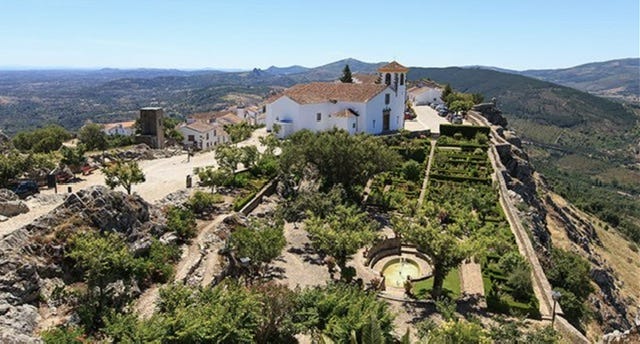
Perched at nearly 900 metres, Marvão is the kind of village that feels imagined long before it was built- white houses clinging to granite like huddled sheep, the keep rising above them like a stern shepherd. The Templars held the fort here in the 12th century, guarding the high borderlands for the king of Portugal. You can still see their practicality in the architecture: arrow slits angled to watch the Spanish plains, a cistern vast enough to withstand a months-long siege.
On windy days, Marvão seems to lift from the earth. The world spreads below in every direction: the Serra de São Mamede, the cork forests, the Spanish frontier. Portuguese Nobel laureate, José Saramago, described the views from the hilltop town as: “from Marvão one can see the entire land… It is understandable that from this place, high up in the keep at Marvão Castle, visitors may respectfully murmur, ‘How great is the world.’”
The name Marvão dates back to Islamic times, reportedly from the name of Ibn Marwân, a Muwallad warrior, who established neighbouring Badajoz (now in Spain) and used Marvão as a fortress settlement. Other traces of the Islamic era can be seen in the surrounding São Mamede mountains, where irrigation technology, land terracing and new crops reflected the influences of al-Andalus.
Food here too is deeply tied to the borderland identity: ensopado de borrego (lamb stew), cabeça de porco in winter, chestnuts in autumn. Chestnuts are a kind of religion in Marvão – roasted, stewed, baked into sweet, heavy cakes. Every November the Festa da Castanha draws the region together, a reminder that community endures even as population thins.
Choose to visit when the international film festival or the classical music festival is underway, and you’ll see the whole town spring to life.
2. Valencia de Alcántara (Spain): A Border Fortress
A short drive from Marvão is Valencia de Alcántara, a town whose Jewish heritage is woven into its architecture. Here Christian, Jewish and Arabic cultures lived side by side until the expulsion of the Alhambra decree of 1492 with many of the Jewish families fleeing to Portugal at that time. In the sprawling Barrio Gótico-Judío, medieval streets form a labyrinth – narrow lanes, lintelled doorways, granite blocks smoothed by time.
The Templars once passed here too – this was a staging post on the pilgrimage route to Guadalupe, and the order maintained a presence in the region. Later, during the Peninsular War, Wellington’s troops marched through on their way to storm Badajoz.
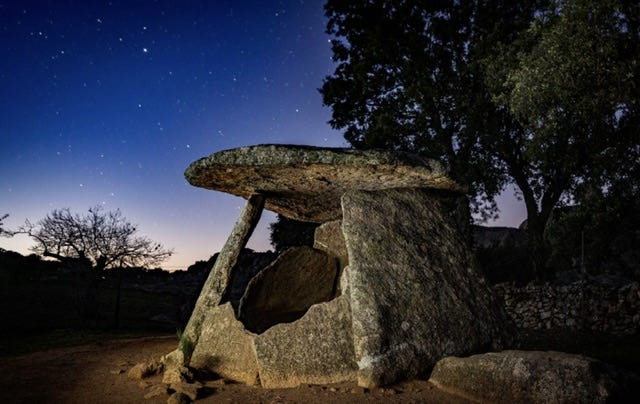
Dating back further, the area is home to over 40 dolmens – Neolithic burial tombs of granite or slate – making it one of the largest and most noteworthy megalithic sites in Europe.
Today, Valencia de Alcántara bears the marks of slow depopulation: shuttered shops, quiet afternoons, young people who leave for Cáceres or Madrid. But there is gentle resilience too: ageing couples sitting beneath the plane trees, the smell of migas extremeñas drifting from kitchens on cold mornings, and the town’s population swelling in the summer months as younger people return home.
3. Castelo de Vide (Portugal): The Healing Spring Town
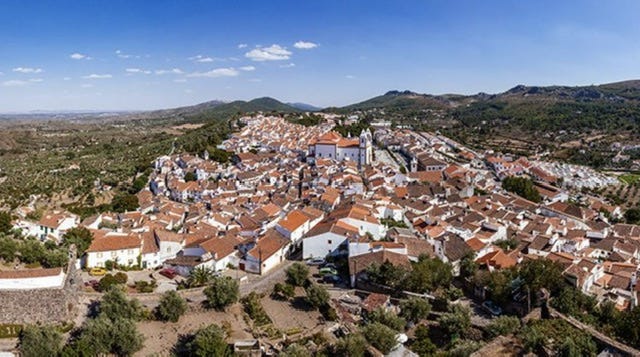
A few kilometres from the frontier stands Castelo de Vide, softer and greener than many border towns thanks to its natural springs. The Fonte da Vila bubbles up in the centre, its waters long believed to heal everything from melancholy to stomach ailments.
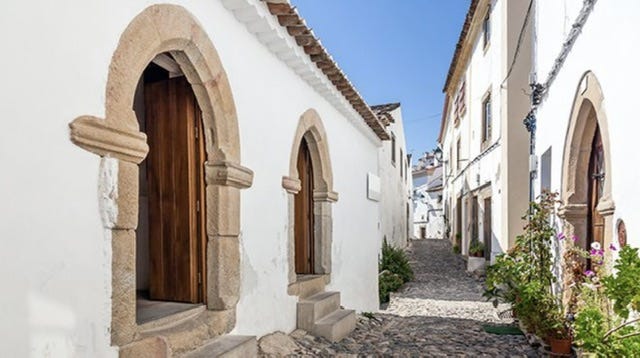
The Jewish quarter here is one of the best preserved in Portugal, its synagogue tiny and intimate. During the expulsions of 1492–97, many Sephardic families crossed the border to settle here, carrying with them Ladino hymns and stories. Walk the cobbles early in the morning and you’ll gain a sense of the medieval past of the town.
Food here is simple, herb-scented, borderland fare: açorda, porco preto, soups thick with coriander and potatoes. At Easter the town is alive with music and processions, the streets edged with rosemary and wild flowers.
4. Olivenza / Olivença (Spain… or Portugal, depending who you ask)
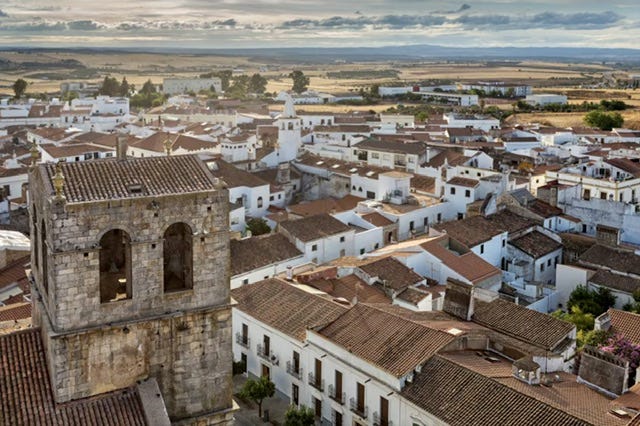
No borderland list is complete without Olivenza: claimed by Portugal until the early 19th century, administered by Spain ever since, and emotionally – culturally – somewhere in between. Street signs remain in two languages; older residents slip between Portuguese and Spanish with the ease of water flowing from one streambed into another.
You’ll hear phrases like:
- a gente vamos
- local expressions like saudadezinha, a diminutive of saudade
The Templar-built keep still stands over the town, squat and square. And the cakes – tortas de Aceite, bolos de amêndoa – mix Iberian traditions as naturally as the speech of locals.
Depopulation is visible here too, but less stark; perhaps the tug-of-two-identities offers a kind of cultural ballast and keeps locals engaged in the future of the town.
To understand the debate over whether the town is Portuguese or Spanish, this article in El País gives an interesting insight.
5. San Vicente de Alcántara (Spain): Cork Oak Country
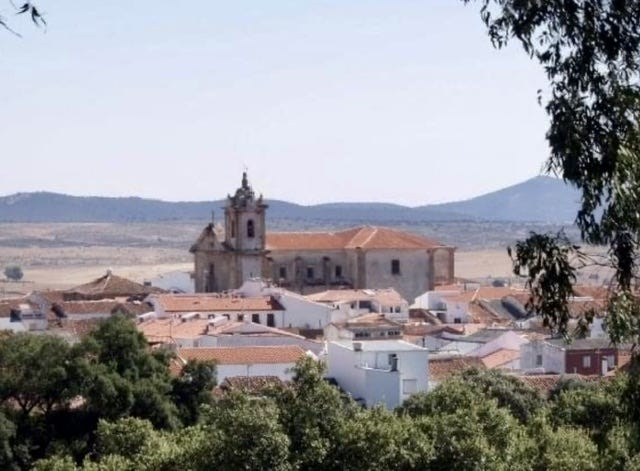
Further north, San Vicente de Alcántara is the beating heart of Extremadura’s cork industry. The landscape is all dehesa: rolling pastureland, cork oaks standing like patient elders. This is a working frontier town, not as dramatic as Marvão or as fought over as Olivenza, but deeply rooted in the rhythms of land and labour.
For centuries, the cork trade here crossed the border freely – Portuguese bark, Spanish producers, mixed crews of workers drifting back and forth depending on the harvest. Today San Vicente wrestles with the same dwindling population as many rural border towns. But during cork season, the place hums: tractors rattling past the plaza, workers stripping bark with a skill passed down through generations, the scent of warm earth everywhere.
Challenges of depopulation on rural village life
Depopulation is a real issue and challenge for these rural communities. To go deeper into how the shift to cities is shaping this part of Spain and Portugal, read this Guardian article on Empty Spain and for Spanish-speakers read La España Vacía.
Many villages are taking steps to attract new residents and visitors. I enjoyed this piece ‘The Villages of Spain’s Fast Emptying Rural Heartlands Have Plenty to Teach Us’ for a more positive take on the possibilities of rural living.
Why La Raya Matters
Travelling these borderlands is a lesson in permeability: of language, culture, memory. Spanish softens into Portuguese; Portuguese borrows from Spanish. Stories cross easily. People cross easily. And yet the border is real – an inheritance of treaties, wars, negotiations, and quiet, everyday resilience.
These towns are not on the standard tourist trail, but they deserve attention – precisely because they reveal what borders can be: not just dividers, but meeting points. Places that blend, overlap, embody slow rhythms and share rich history.
Laura McVeigh is a Northern Irish novelist and travel writer. Her work is widely translated and her latest novel Lenny is set between the desert in Libya and the bayou in Louisiana. She has authored books for Lonely Planet, DK Travel, writing published by Bradt Guides, bylines in the Irish Times, Irish Independent, featured by the BBC, Newsweek, New Internationalist & many more. Former CEO for a global writers’ organisation, working with writers from 145 countries. She is founder of Travel-Writing.Com and Green Travel Guides. Laura writes on storytelling, travel writing and mindful travel on Substack.